


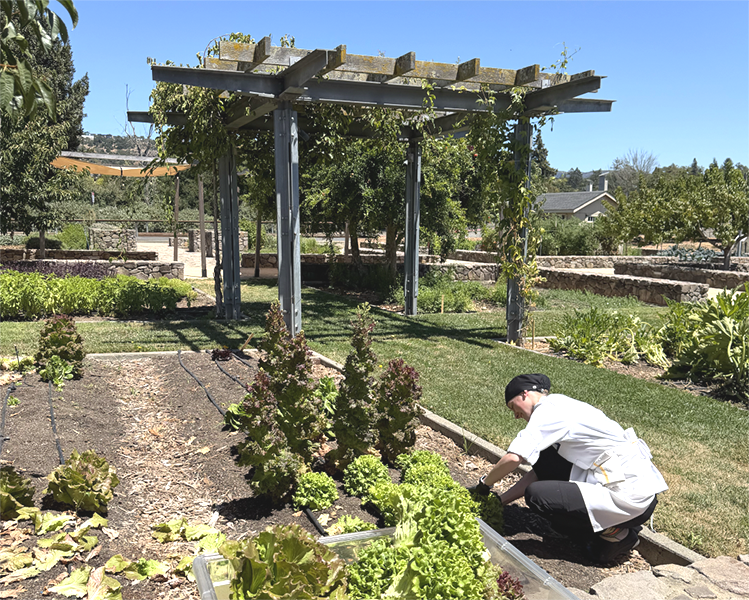
Welcome to the latest installment of Field Trip, our series that goes inside gardens and farms across the globe and spotlights the interesting people who keep them alive. Today we’re talking to Casey Kimmel, who manages the Culinary Institute of America’s Copia garden in Napa, about miraculously maggot-free figs, how to kill pests with potatoes, and why changing your life to become a gardener is a very, very good idea.
PS: this post is too long for your email — please click here to read it in a browser or on the app!

As someone who’s killed half of her summer’s garden, I’m lucky I know how to turn on a hose let alone tackle the unique, complicated history of gardening in the modern United States. My education in this area is limited to less-than-basic knowledge about the Three Sisters method of planting, as well as stories passed down from my longtime neighbor Jimmy Williams, the famed L.A.-based edible gardener whose enslaved great great grandmother smuggled tomato seeds aboard a ship that docked in Charleston in the 1800s. As I’ve mentioned in a previous post, there will be much more to come here about Jimmy (and his business partner and son, Logan) in a subsequent issue.
But today, we’re talking with Culinary Institute of America garden manager Casey Kimmel, who started his own gardening journey by planting some tomatoes that his partner, a captain at The French Laundry, brought home from work one day. Since December 2025, Kimmel has managed the day-to-day operations at the CIA’s 1.5-acre Copia campus garden in Napa, a teaching garden that services The Grove, the property’s professionally-run restaurant. It’s also utilized by students enrolled in the school’s intensive 30-week Accelerated Culinary Arts certificate program.


Bradley and I have been visiting the CIA Copia garden every summer since 2023. We’ve made a point of stopping by this open-to-the-public space every time we drive up to Napa — typically one week each July to attend the Napa Valley Writers’ Conference. I call it writing camp: a magical week away from memos and Slack and meetings about meetings to workshop fiction with fellow writers, listen to readings by Pulitzer Prize winners and former U.S. Poet Laureates, and engage with the tiny, infinitely complex details that make really good writing a decidedly human affair.
The week is always packed with activity. But at some point, every single summer, without fail — usually after turkey cheeseburgers and chocolate/vanilla swirl soft serve at Gott’s Roadside — Bradley and I walk across the parking lot from Napa’s Oxbow Market to the CIA’s lush eden and wander the rows of produce. Think of the sprawling space as a city park that just happens to be overflowing with Greek oregano, grapefruits, bespoke tomatoes, and restaurant staff in chef whites harvesting lettuce.


Copia was originally conceived in 2001 by Julia Child and wine legend Robert Mondavi as The American Center for Wine, Food and the Arts. The massive building’s garden, though under various stewardships since, has remained largely as it has always been. I love the garden’s peaceful yet productive energy. It joyfully haunts the part of my brain that’s actively planning the Ojai kitchen garden I’ve been dreaming about for years. As soon as I started Going to Seed, I knew I wanted to learn more about this place — not only to understand the practical tactics of how to grow crops I could cook with, but also to try and grasp what it means to create a culinary garden befitting the very institution responsible for training some of our country’s greatest professional chefs.
A former chef himself, Kimmel — who worked on farms before attending culinary school — ramped up his gardening game in 2020 when he noticed how distance learning kept his son glued to screens. “That didn’t sit right with me, that he just wanted to sit in front of a computer all day. So I turned our backyard into a farm.”
Gardening soon became Kimmel’s “spiritual bleach” (a cleansing sensation I personally experience every time I spend a mere five minutes in my herb garden between Zooms). When it came time for the world to start again, he wasn’t content going back to his old, stress-filled life as a chef. So he got a job working as a farm manager at the Sonoma County Mycological Association, where he taught farm-to-table classes to kids.


“Gardening is patience, and it’s taught me patience,” Kimmel said while walking me through the Copia garden on a perfectly sunny morning in July, just before I was due to workshop the first chapter of my novel-in-progress with food journalist and author Michelle Huneven. “I become a better everything — a father, partner, everything — just from gardening. I was a chef for so long. So this is like therapy.”
Before my own gardening journey began in earnest, I’d always noticed the Copia garden’s “basics:” basil, lettuces, cucumbers, and citrus taking up whole corners and squares of the space. But once Kimmel — along with his CIA colleague Ariel Sinclair-Chin — dove into the details of each crop and the growing methodology behind them, I realized that there was nothing “basic” about it. Lettuce is Jeok-sangchu, a red leaf variety from Korea. Citrus is Australian finger lime and Filipino Calamansi. And there are five kinds of basil – including a Greek variety and Cinnamon basil, originally from Mexico.
Kimmel spent time cooking and teaching in Japan, and his culinary proclivities are a melting pot of their own, influencing how he grows and cooks at home (his inability to easily source the ingredients he was accustomed to using in more metropolitan locales contributed to his home garden planning). This all got me thinking about the idea of “American gardening.” One might argue that it’s necessary to think about “American food” at the same time, too. But what even is “American” food? Yale Historian Paul Freedman, whose book American Cuisine and How It Got This Way came out in 2019, says that our “experience of being able to choose among international restaurants is part of the overall story of American cuisine.”


My own version of “American” cuisine dates back to a SnackWell’s-era childhood spent in the Chicago suburbs, where my grandma Roz would make her honey sponge cake and Matzo Ball soup from a box during the Jewish high holidays. There was also much Chinese take-out (of the orange chicken and fortune cookies variety) along with my dad’s stories about his grandma Yetta’s Kishka — intestine casing stuffed with sausage and vegetables — made from scratch. Bags of frozen Birds Eye corn were the norm. But Dad also spent summers grilling fresh sweet corn and steak burgers in our yard to a soundtrack of chirping cicadas. We guzzled the face-puckering Country Time lemonade that I sold (along with friendship bracelets) on our corner. And every so often we’d order a buttery, cheese-topped brick of Lou Malnati’s deep dish as a weekend treat. Despite the research-lite writing staff of ‘Emily in Paris’ calling this pizza “quiche made of cement,” Lou’s is still something my family orders for special occasions, packed in dry ice and FedExed to California.
My repertoire expanded once I moved to L.A.’s Koreatown in 2008 and BCD Tofu House and Kyochon Chicken rotated as my late night drunk food spots of choice. But even as I’ve gotten older and have experienced the mouth-tingling joy of Sichuan Chongqing chicken in the San Gabriel Valley, had Oaxacan mole down the street from my Silver Lake apartment, and enjoyed some of my favorite non-Parisian coq au vin at a bistro in Northern California, I’ve always thought of the way I eat as fundamentally American. To me, American cuisine is every culture and taste freely existing and comingling, offering up the things that we Americans seem to value most: abundance, variety, and the agency of choice.

I’m not sure why I was so surprised at the sheer variety of global ingredients growing in the Copia garden. Maybe because now that I live in an agricultural valley where native plants and the idea of rewilding dominates most gardening conversations, growing anything that doesn’t explicitly “belong” feels a bit shameful.
Of course there are countless heirloom varieties of corn, okra and the like that are tied to hyper-specific regions and can be traced back through thousands of years of this land. But when I think about an “American” culinary garden experience — especially one that’s open for anyone to enjoy — I love the idea of a garden that reflects of our country’s current diversity through a universal experience that connects us all: eating. And that’s exactly what I believe the CIA Copia garden achieves.
Below, Kimmel dives into fascinating specifics (e.g. non-chemical pest control for dummies) of how he believes we should all be thinking about the kitchen gardens — “American” or otherwise — of our dreams. Our conversation has been lightly edited for length and clarity.
Being in this sprawling, thriving garden makes me so excited to keep planning and building my own, but I also know I can’t do this at my house (or anywhere, for that matter). But what can I do? What should someone like me — a beginning gardener who has very little clue and also loves to cook — be asking when planning a personal kitchen garden?
Casey Kimmel.: What do you like to eat? That’s the perfect question. My home garden is my store. I go out and get things for dinner. Weeknight dinner at my house is miso soup. Whatever’s in the garden — carrot, radishes — my son makes the miso with me. I used to teach elementary school in Japan and kids do that in school in Japan, they learn how to make traditional foods and grow rice.
Previously I lived in Silicon Valley. And Silicon Valley is like New York in the suburbs, because it has everything. Every culture is represented. Every country. You can buy anything, and I eat a lot of Asian produce. And then I got to Napa, and there was nothing. So this is one of the first things I grew because I eat a lot of it, and I still grow it at my house. This is Sungiku, edible chrysanthemum. The chefs use them on plates. You can eat the flower. You can put this directly into a salad as well. I usually stir fry it or put in miso soup.


What else is happening in your herb section?
C.K.: We were going for something. We wanted to have an Asian herb garden, a Latin herb garden, our woody herb garden and our kind of continental European herbs. I have grown none of these [Latin herbs] before in my life, save for cilantro.
We let the cilantro flower because it's beautiful. It smells good. Goes on cocktails. Goes on plates. And we want it to go to seed because you can treat them like a peppercorn. And that's why you want a garden associated or connected to your restaurant— you can eat the plant at every stage of its development. And even when these completely go to seed and they're gone, you can eat the roots.
That’s so funny because last time I grew cilantro, I thought I failed when it started to flower. I thought I didn’t deal with it fast enough.
C.K.: Nope, you can eat it, you can enjoy it in every stage of its development. You can’t do that if you’re buying from a purveyor.


There's so much organization here, which I highly doubt I could achieve myself in any capacity. Is there a “right” way to grow herbs at home?
C.K.: Well, growing them at the right time of year. Like you said before: cilantro. Maybe it was too late in the season, so it bolted quickly. Cilantro doesn’t like heat. Start cilantro in the spring or even before indoors, like in February. We started all the cilantro here in February and we had cilantro all winter. We actually produce in this garden all year long and we don’t have an off season. So all winter we were doing brassicas, mustards, fennel, and herbs.


Tell me about your cucumbers.
C.K.: Cucumber season is coming to an end. But I was able to get this one this morning, it’s very special. This is a Eun Chon cucumber, a Korean variety. I like to call it the king of cucumbers because it does it all. It slices. It dices. It stir fries. It kimchis. It pickles. It does everything, and it maintains its really good texture. And it’s really pretty, and the skin is completely innocuous and edible. And unlike a store-bought cucumber, they’re not coated in wax. So, store-bought cucumbers — no shade to them — but they have to travel, and they'll dry out really quickly. That's why you get the English cucumbers like totally wrapped in plastic.
I see a section of really remarkable looking, oversized squash.
C.K.: This is this year’s summer squash. So I got a text from another farmer that she was shocked. She said, "Why are your summer squash so big already [this early] the season?” It's because we started them so early. We were able to because right here at Copia, we sit on what's called the oxbow [river bend], like the Oxbow Market. We're surrounded by water on three sides, so we have a little microclimate where it never really gets that cold here. We had these guys in the ground in April.


I have no idea what “early” means in relation to summer squash. When’s a typical time to plant them?
C.K.: Like very, very, very late spring. One of the varieties we're growing this year is the yellow bar, which has become my favorite. The texture is creamy. And the other thing I like about these guys is they don't grow as fast as other zucchinis — if you turn your back, they're ginormous. If I don't harvest them in one day, they're huge.
This is my previously favorite variety, a cocozelle. If you can, Google Thomas Keller's zucchini recipe. Do you know it?
I don’t. But I would like to.
C.K.: It's called zucchini pudding. It's very simple, and when I was a farm-to-table teacher in Sonoma I used to do it with the kids. It's really good, it's very simple. It's just salt, pepper, olive oil, and zucchini in a pan and an oven.
I have all of those things except for squash from this garden. If I did want to grow summer squash at home, how do I make sure I’m not getting overrun?
C.K.: Do one plant. Only one plant. Harvest it frequently when [the squashes] fall. They'll double to twice their size in a day.
So I was going to take you over to the edible flower garden and see what we have going on
I’m always down for an edible flower. But I have to ask — why are there figs growing in the center of the edible flower beds?
C.K.: You know that is a very good question. I got to eat at Hestan a few weeks ago. And I talked to Chef Mark Dommen, who was one of the first chefs here when it was [named after] Julia Child. And I got a little perspective about this garden from him, from what it was like 25 years ago. Back then, every field block was actually connected to a wine varietal. So it'd be like “the Cabernet block,” and everything in the block would either complement Cabernet, or would show up in the tasting notes of Cabernet.


I’m wondering because I’m curious if planting fruit and flowers near veggies is something one should do at home for better pollination.
C.K.: My gardens are always better when I put flowers in with my vegetables. Speaking of figs, we’re lucky because we escaped — this year in Napa, there’s a fig fly. It’s really bad. It’s a maggot. And if you have it, you’d have to take every fig off your tree. So I immediately came out here to check our figs [to see] if there were maggots in them, and there are not. So we’re golden. We’ll probably be one of the only people in town with figs. We’re safe here. Actually, a lot of pests that I've had in my home garden I've not seen in this garden.
Really? Why do you think that is?
C.K.: I haven’t figured that one out yet. A little bit of magic?
On the topic of pests, let me ask you practical advice on nasturtiums. Mine have gotten a pathogen. They seem to have died. I think I sprayed the neem oil too late. When is the right time to spray neem oil (or any other non-toxic compound) on something if you notice little black spots?
C.K.: As soon as possible. It can either be preventative or used to fix the problem. But I’ll be honest, I’ve never had that problem with nasturtiums. It could be your soil. It could be the time of year. It could be that something around them is attracting [pests] because sometimes bugs will have viruses and bacterias in their mouths. Like a cucumber beetle is so destructive not because it nibbles on the leaves, but it can infect your plant with a pathogen when it bites. That’s why we try to prevent. Spray the leaves with either neem or clay. There’s a product called Surround WP and it’s just pulverized clay. You put it in water and you spray it.
We don’t use any chemical pesticides, we use preventative organics like neem. I planted cabbage when I first got here, and they completely and totally failed. So I asked Rachel, our consultant gardener — and she had dealt with this before — she told me about symphylans, a soil pest. In my gardening journey up to this point I never had to deal with them, and they live in the soil and can go as deep as three feet.
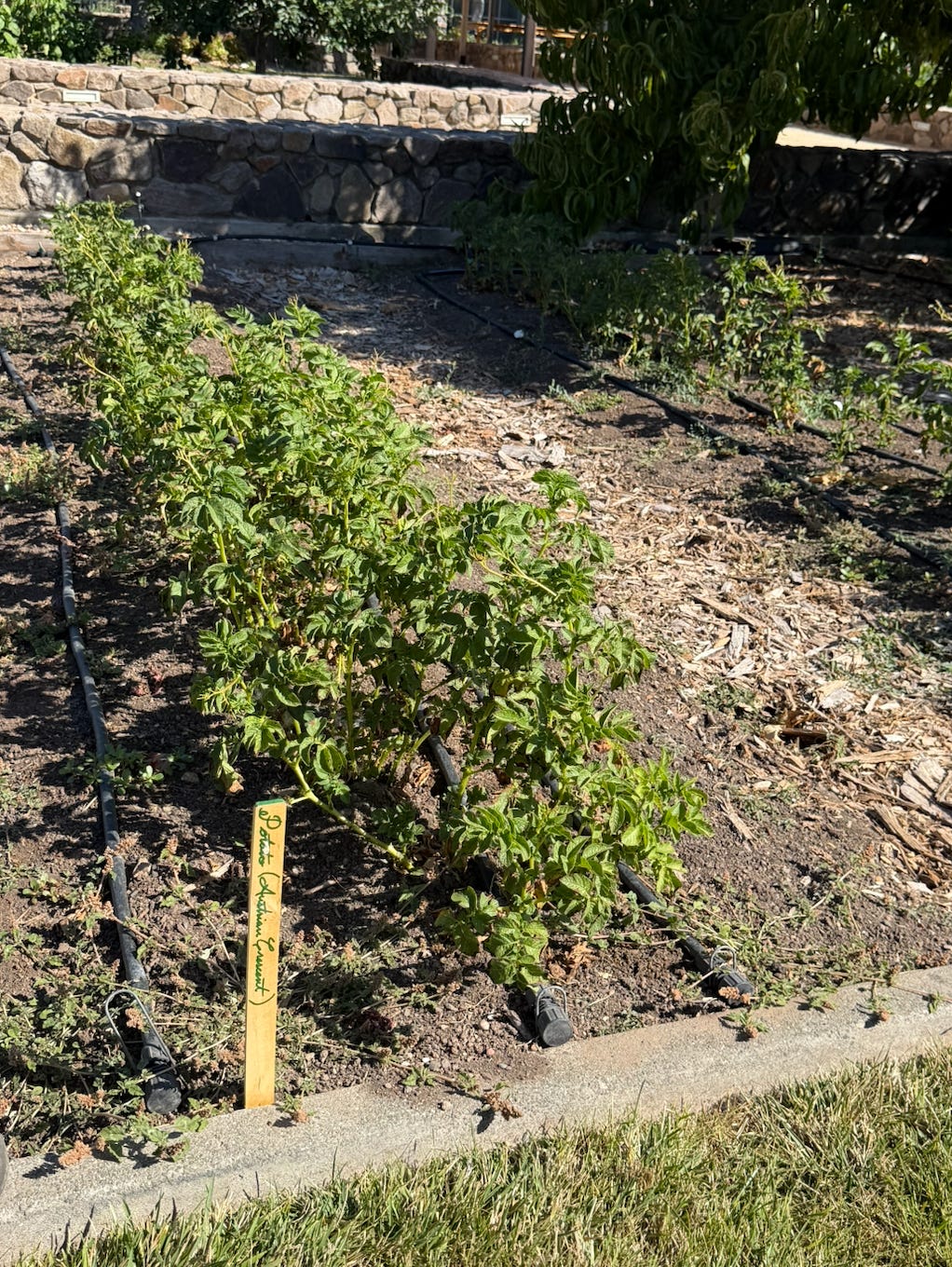
Because we don’t use commercial products to kill pests, this is her strategy: Growing potatoes in that [infected] bed for a season will interrupt their breeding cycle and collapse their population, and then you can grow something [else there] after.
You get a potato, cut it in half, put it face down in the soil, bury it, cover it and leave it there for two or three days. Come back and the symphylans will be crawling all over. They’re very small. You can almost not see them with the naked eye — they look like little tiny, tiny white centipedes. They’re most active in spring because when it gets too hot, they go down deep. But we work with them. They’re part of the ecosystem.
I’m fascinated by the fact that your row of citrus ripens in succession.
C.K.: John, the gardener who was here years before me, put in this entire citrus row. We literally have citrus year round. When one tree is coming into fruit, the next one is just starting, and it just goes down the line. John set up a lot of things like that in this garden. You should have been here for stone fruit season, three varieties of apricots would ripen in succession down the line.


How do you plan something like that?
C.K.: Experience. Or, when I started gardening, the biggest resource to me was the UC Master Gardener program. They’re still always experimenting and doing tests. So their data is always current about when to start something and when it’s going to crop. That’s just the best way. It’s as simple as that. Follow them. That’s a good way to start. And then maybe you’re in a microclimate where it doesn't quite work. And then you can learn to adjust it.
And you have a seed library!
C.K.: We host the seed library. Unfortunately, it’s closed at the moment because it got too hot. Lauren, the lady who runs [it], comes out and she’ll take everything in. This is like a give a seed, take a seed type situation. So if you have a variety that you have been growing in your garden, and it works well in Napa, you’ve grown it many times — it’s heirloom, it’s open and pollinated — you can put it in an envelope and donate it. I’ve donated to it. I’ve grown San Marzanos in my yard for the past seven years. And I always choose the most successful ones to get seeds. So maybe if you get San Marzanos from here, they were from my home garden.


We have a seed library at my local community garden, which I’m eager to get more involved with. But I’m nervous to grow things from seed. For some reason, transplanting feels safer and less prone to failure. I know failure is part of the deal here, but I don’t like it.
C.K.: Well you said you thought you failed with your cilantro. But actually it was a great success.
Absolutely, I love that reframe. I also love how gardening redirected your life. You seem really happy that you changed careers.
C.K.: People stop me every day in the garden, and they say, "You know what? You have the best job in the world. And without any irony, I look them back in the face and I say, "Yes, I do.”
Enjoyed this piece. I too am a proponent of growing herbs, flowers, and vegetables together particularly since the average home garden is often small.