

Let’s Talk About Lavender Part II
Nursery School: Keep Your Own Lav Alive

Welcome to “Nursery School,” where we’ll learn how to do things like not killing your basil and understanding the difference between an annual and a perennial, among many other basic (and not so basic) items.

For the last 15-ish years, Clairmont Farms has provided my lavender fix not terribly far from home. Located in the darling Santa Barbara wine country town of Los Olivos (once of Sideways film fame and, lately, better known for a new-ish Auberge, nearby Michelin-starred deliciousness and Jenni Kayne’s all-white “ranch”), the tiny no-spray farm and its home-grown, no-frills products are a welcome respite from the world of homogeneous, TikTok-ified beauty brands.
Once you turn into the property’s blink-and-you’ll-miss-it driveway, you’ll be met by 175 year-old olive trees that stand guard over rows of purple Provence and Grosso lavender bushes and a shed-sized retail boutique. The five-acre operation is owned by mother-son-duo Meryl Ann Tanz and Sean Crowder, who have been growing lavender on their land since 1998. And now that it only takes me an hour and change to drive to this magical place from Ojai (Clairmont makes an especially lovely post Bell’s lunch pit stop), it’s easier than ever to replenish the organic essential oils, body scrubs, culinary-grade lavender sugar and loose-leaf teas I’ve loved for so long.
On a recent visit, I told Crowder about the in-ground and potted English lavender Bradley and I inherited at our house. I also told him about my very real pruning anxiety.
“Pruning lavender is actually very easy to screw up,” he assured me. “Don’t worry about it.” I worry.
Thankfully, he offered some useful wisdom to help master the art of this majestic, fragrant flora.
Give Your Plants Space
Standard Spanish, English, and French lavenders can grow to roughly 3 feet by 3 feet, with some French varieties clocking up to 8 feet across and big English types topping out around 4 feet by 4 feet. Better stated, these are not tiny plants. Choose a large enough pot or planting area so your plant’s roots and canopy have room to spread and grow.
Don’t forget about depth. Give your new plants about a foot down in the dirt so it’s easier for them to establish roots and thrive.
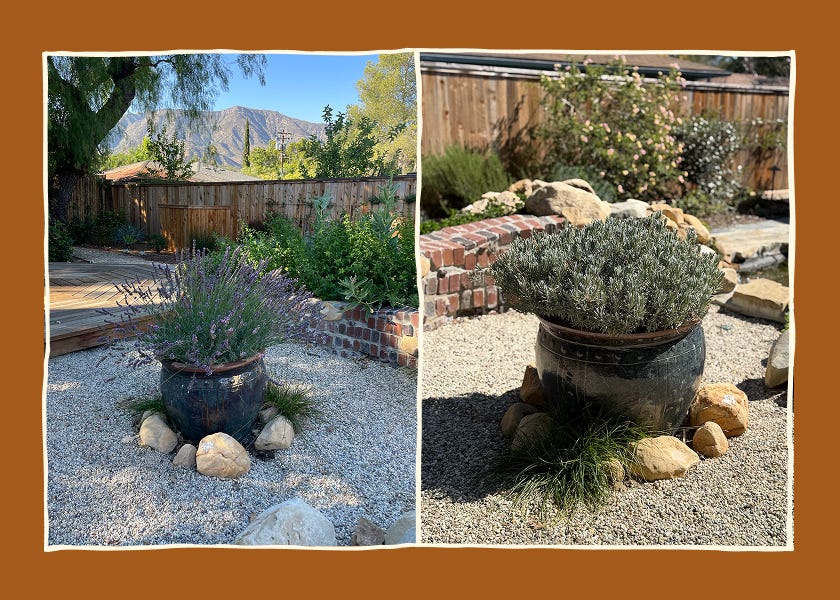
Don’t worry if you really want to house your lavender in a small pot you love — for now. “You don’t have to immediately put [your plants] into a huge box,” Crowder says. “But they do have to go into one within a year or two.”
Water Lavender Like a Succulent
Succulents don’t need a ton of water. And neither does lavender.
“No sprinklers!” says Crowder, warning against getting your plant’s leaves wet. Apparently, wet lavender leaves are likely to burn in the summer sun. Use drip irrigation or water your plants by hand at the soil line, instead.
Again using the succulent rule, aim for a thorough soak every 3-4 days depending on the weather. Water less when it’s hot, and a little bit more when it’s cooler. If you’re watering by hand, aim to give young plants a quarter of a gallon at a time. When a plant hits maturity at three years old, that amount jumps to a third of a gallon. If you’re in extreme heat, add an extra cup or two. “If it rains, don’t touch it for like two weeks.”
Make friends with a dipstick. Only water your plant when it lets you know that your soil is dry 2-4 inches deep (call me a cheater, but I adore the under-$12-water meters I picked up at our local nursery, no measuring required).
Protect Your Roots
If you’re planting new lavender, know this: most lavender roots tend to fan out near the surface, making them vulnerable in extreme heat.
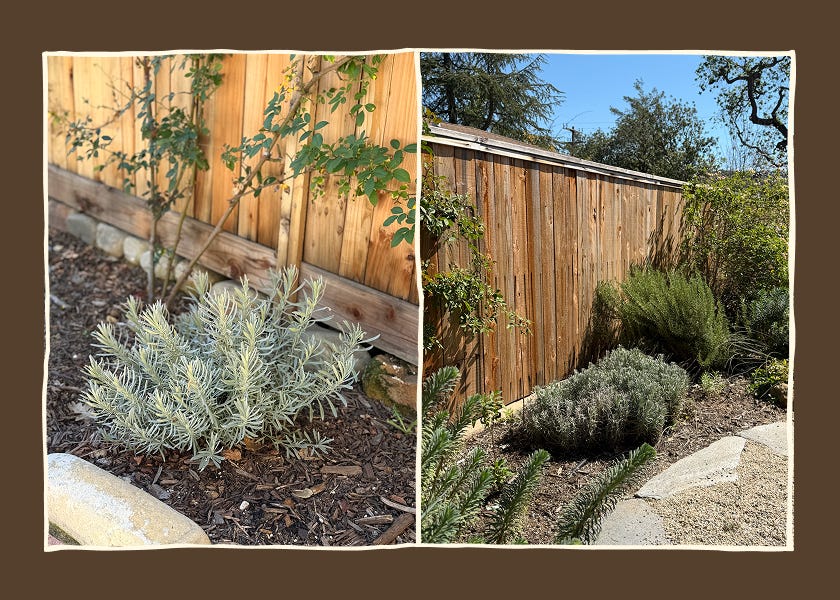
In hot areas, mound the soil and plant your plant in a shallow “cup” or bowl so the crown is up but the roots are buried under a couple extra inches of soil “so as light and heat hits it, it’s not going to penetrate and kill the roots.” says Crowder.
Prune With Restraint
Prune your plants twice a year: once in the fall after your plants stop flowering (expect to cut back about 1/3 of your plant during this one), and again — though with a lighter touch — in the spring, once green growth starts to show (and helps you know where to cut).
If you take one thing from this interview, let it be this: “Never cut below the leaves. Ever.” Crowder warns.
The occasional exception to cutting into woody undergrowth is Spanish lavender, which is heartier than French and English varieties. “But never more than a third [of the plant] at a time.
For English and French plants, cut the stems 1 1/2 inches into the leafy section “at most.”
“If you hack it back [to the woody part], you’ve killed it.” Noted.
Clairmont Farms, 2480 Roblar Ave., Los Olivos, CA. 805-245-6525