

So What Does Going to Seed Actually Mean?
My flowering basil is making a mess at the community garden. Here's why, and how to fix it so I'm invited back next season.

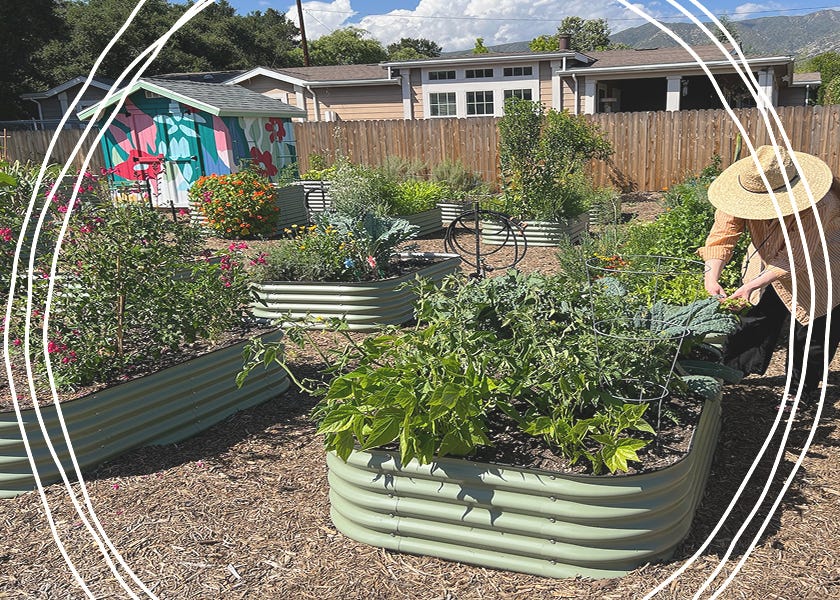
Welcome to “Nursery School,” where we’ll learn how to do things like getting rid of caterpillars on our kale and keeping mint from ruining everything. Today, Meiners Oaks Community Garden founder Barrie Cohen explains what it means when a non-fruiting plant flowers before it should, why it matters, and how to deadhead your plants.

I’d always thought “going to seed” was just a colloquial term for “fucked.” As in, “he stopped working out and went to seed.” Or, “We have nowhere to live after a wildfire and our major global insurance carrier is ghosting us. Our lives are going to seed.” So it was with that logic that I chose the name of this very publication, which I dreamt up last May while displaced and living in a VRBO, feeling very much like my life was quite messed up. Also, gardening! And the name of this Substack was officially born.
As I’ve gotten more distance from those life-changing wildfires of 2025 (while still dealing with a very real aftermath that includes the logistics of said displacement), I’m trying to make space again for things that nourish my soul — like trying to make my long-held dream of having my own on-site kitchen garden a reality.
When Bradley and I met Meiner’s Oaks Community Garden founder Barrie Cohen at the Deck the Halls holiday pop-up market last December, I didn’t really think about renting a raised bed or joining her community (I mostly wandered over to her booth because she was selling cute tote bags). After all, our yard has room for beds and even some bare dirt calling out for cultivation. But I also consistently spend way too much money and time on hobbies and “movements” that lead nowhere (In 2006 I spent $300 on a food dehydrator because I decided to exclusively eat things that were raw, only to scrap the idea a few weeks later after getting food poisoning from Whole Foods sliced papaya. The book that got me into raw food in the first place was later adapted into a Netflix documentary about fraud).
Given this track record, ripping up the concrete on the side of our house to install the lush Eden of my dreams when I legitimately don’t know how to garden seemed like a rather foolish idea (and one that would have had a larger out-of-pocket consequence than a small appliance from Bed Bath & Beyond). Instead, I decided that renting a raised bed at Cohen’s garden would offer the right amount of support and resources (soil, compost, tools and fellow growers) so I could crawl before I run.
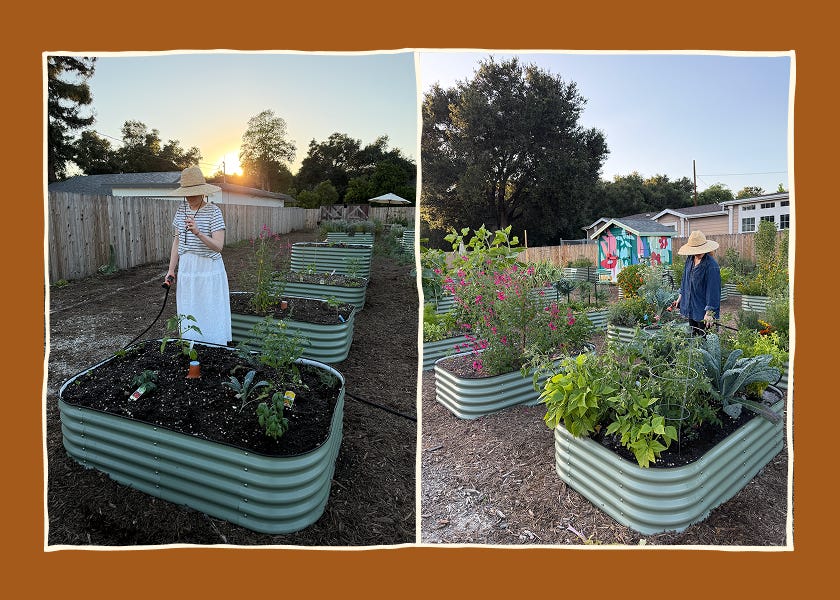
Cohen, who grew up in very non-rural New York, later spent time working on farms in Oregon, New Zealand and upstate New York and also studied agroecology and sustainable food systems at UC Santa Cruz. She discovered Ojai during a 2 ½ year van trip throughout North America (Mexico and Alaska included). In 2023, she found an underutilized piece of land attached to a former citrus orchard in the Meiners Oaks section of town (an area somewhat akin to L.A.’s artsy, cool Echo Park). And in 2024, the 38-bed no-spray garden officially opened its gates and now hosts community events and classes in addition to being a cheerful, verdant space that truly acts as a bright spot during any day you’re there.
“Where we are in the world, it’s really important for us to be more together, and to learn how to grow your own food, be empowered to grow your own food, and do it in community,” Cohen said during a chat in her garden earlier this month. “I have space for a bed in my backyard, but this is more fun.”
The other week, she sent an email to members with some housekeeping items. Including this:
Plant Maintenance: I noticed some plants are starting to go to seed. Please deadhead any flowering plants to prevent them from spreading throughout the garden. If you are unsure how to do this, please reach out and I would be happy to assist you.
It was then that I realized I had no idea what the real definition of “going to seed” actually was (despite the name of this publication), and I certainly didn’t know what to do about any plants displaying this behavior. So I reached out.
“To me, ‘going to seed’ means starting anew and starting fresh,” Cohen said. “So if you think about the lifecycle of a plant, it goes from seed to root to sprout to plant, and then the plant flowers, and then from the flower comes the fruit. And then either you eat the fruit or the fruit rots and goes to seed, which means planting its seed in the ground for the next season.”
Julia Yamasaki, Post Ranch Inn’s edible landscape specialist, concurs.
“Your plant has flowered and has created a matured seed and has scattered that seed,” she told Bradley and me when we toured the Big Sur property’s Chef’s Garden in April. “It’s not just a euphemism.”
Whoops.
My uninformed theory on the term’s meaning seems to have been somewhat correct, though, in that an edible plant that has shifted its energy away from its leaves and roots to focus on making flowers will taste bitter and gross (many gardeners also use the term “bolting” to describe this). Fucked, just like I thought.
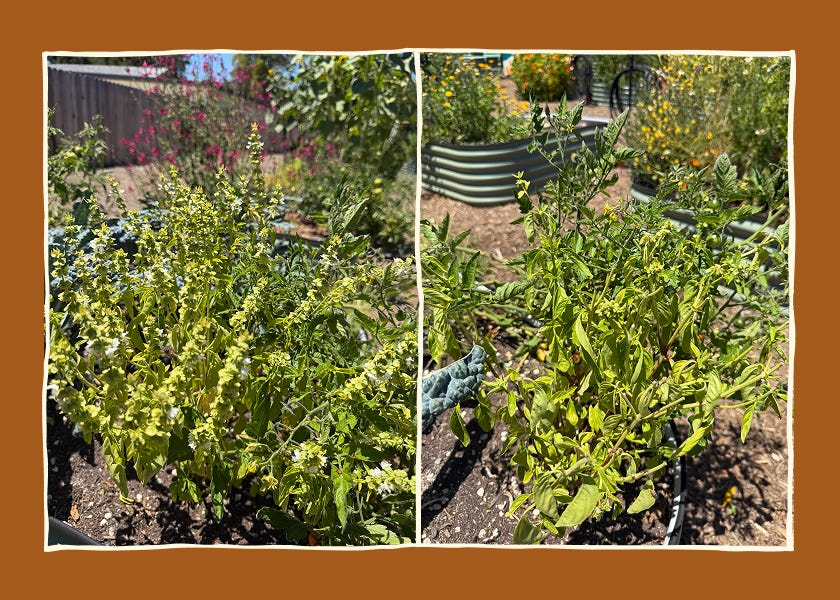
As Cohen and I made our way over to the explosion of white flowers topping a mound of basil in my garden bed, she explained another reason why letting certain plants flower — especially in a communal space — is frowned upon.
“Once [the flower] disperses, it’s gonna be spreading its seed, and there’ll just be basil everywhere. So, when I say [take care of] your plants before they go to seed, it’s just to avoid more weeds in the garden.”
According to the RHS, “bolting” is triggered by a change of day length through the seasons. While the Civic Garden of Greater Cincinnati cites general stress from temperature swings and lack of water as two possible reasons why some crops “go to seed” earlier than their time, rendering them unusable.
When it comes to preventing crops from flowering too early and tasting like crap, there are many different nuances involved — including whether your plant is an annual or a perennial, your climate and your timing. These things are above my current pay grade. Since I’m still in my Gardening for Dummies era, let’s focus on my very basic unkempt basil that seems to be spewing seeds all over the community garden.
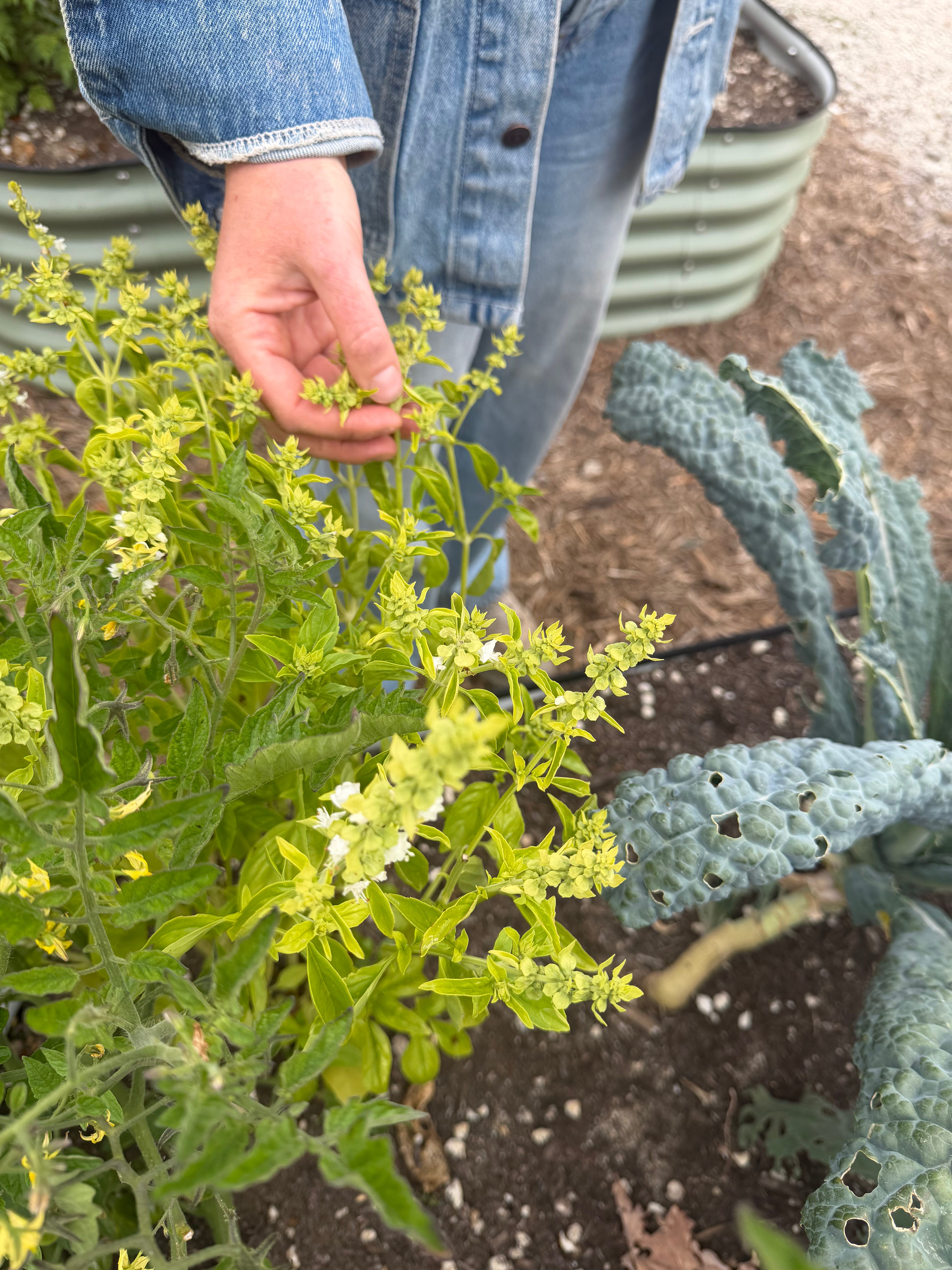
“One thing you can do when you’re growing basil, is when you see it start flowering you can just pinch [the flower] off,” Cohen says. “And the plant will have more life.”
Friends, this is called deadheading.
Easy enough. But how does one tell the difference between a plant that’s supposed to be flowering and one that isn’t and needs to be deadheaded?
“This is not a fruiting plant,” she said, again using my basil as an example. She then looked toward the small, yellow flowers blooming throughout the Sun Gold tomato plant winding across the front of my bed. Tomatoes are fruit. Therefore, this is a fruiting plant and those flowers can stay (though strategic deadheading is recommended to get peak tomatoes — one lesson at a time, expect a future post on tomato pruning techniques for optimal yield).
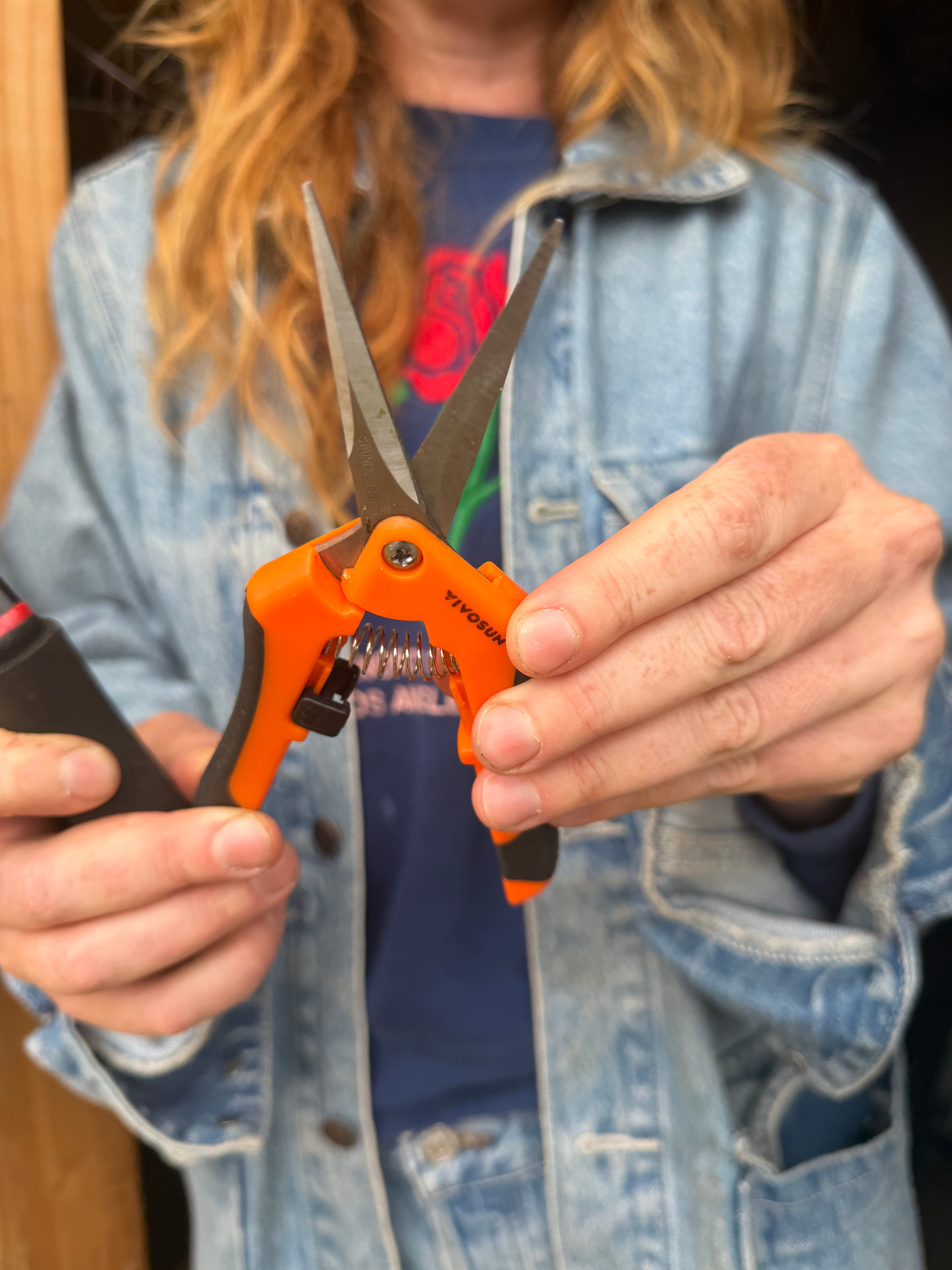
If you don’t want to pinch your flowers, Cohen recommends using a standard clipper. At home, I use a pruner that I bought from a garden supply store. But Cohen says a clipper (or snipper, as some places may call it) has smaller blades and will give you more control and a closer cut.
As for the name of this publication, Cohen thinks I chose well.
“Think of [going to seed] as a cycle, like a circle. So even though life felt like it was falling apart, you went to seed and now you have new leaves in Ojai.”
Yes, indeed.